


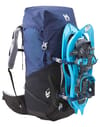
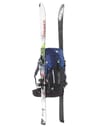
Ubic 50+10 W Black/Dark Blue
Trekking backpack - Women -


 Home delivery from 22/09/2026
 60 days to change your mind
 No subject to promotional offers
The Ubic 50+10 W Black/Dark Blue is a trekking backpack for women from the brand Millet.
Like the entire Millet Ubic range, it is a versatile and innovative 4-season pack that can be used both in winter for ski touring and in summer for multi-day trekking, thanks to its many features. Indeed, it has several straps allowing you to attach all types of equipment such as skis, poles, snowshoes, a sleeping mat, etc. You can also carry your hydration bladder inside the pack.
Lightweight, durable and ergonomic, this pack is also characterised by its carrying comfort. The load is well distributed between the shoulders and hips, while the breathable belt and ergonomic shoulder straps specially designed for the female morphology will provide the necessary comfort to enjoy every minute. If it rains during your outing, you can use the integrated rain cover on the Ubic 50+10 W to keep your gear dry.


- Adjustable chest strap
- Ergonomic shoulder straps specially designed for the female morphology
- Waist belt specially designed for the female morphology
- Reinforced base
- 2 lateral compression straps
- Base straps
- Load reminders on shoulder straps and waist belt
- Hand rest straps
- Lateral zipped access
- Large suitcase-style zipped opening
- Removable expandable flap with 2 buckles and a waterproof skirt
- Front compartment
- 2 lateral mesh pockets
- Zipped front pocket
- 2 zipped pockets on the flap
- Expandable zipped pocket on the waist belt
- Gear strap system
- Key holder
Dimensions: 70 x 28 x 28 cm
Back height: 40-50 cm
Composition:
- Main material: Polyamide 210D Solution Dye with durable water-repellent treatment DWR
- Secondary material: 100% recycled Polyester 600D with durable water-repellent treatment DWR (waterproof rating: 1000 mm)
- Lining: 100% recycled Polyester 250D with durable water-repellent treatment DWR (waterproof rating: 1000 mm)
| ECO DYEING | Thanks to this ecological dyeing, colourfastness is improved, colours are more intense and the risk of bleeding is reduced. Compared to the traditional textile dyeing process, this technology saves more water, uses far fewer environmentally harmful chemicals and produces less CO2 emissions. |


Our Bloch' letter


